
FAQs
General
The Maritime Area Regulatory Agency (MARA) is a statutory body and regulator under the aegis of the Department of Climate, Energy and the Environment with headquarters located in Wexford. It was established by Part 3 of the Maritime Area Planning Act 2021 (MAP Act) and subject to the provisions of the MAP Act, is independent in the performance of its functions.
MARA has a key role to play in the new streamlined consenting and compliance system for the maritime area (as defined in the Act) and its functions are set out in section 43 of the MAP Act
MARA’s remit extends from the high water of ordinary or medium tides to the outer limit of the continental shelf and includes the sea and tidal areas of internal waters. Section 3 of the MAP Act sets out the application of the Act.
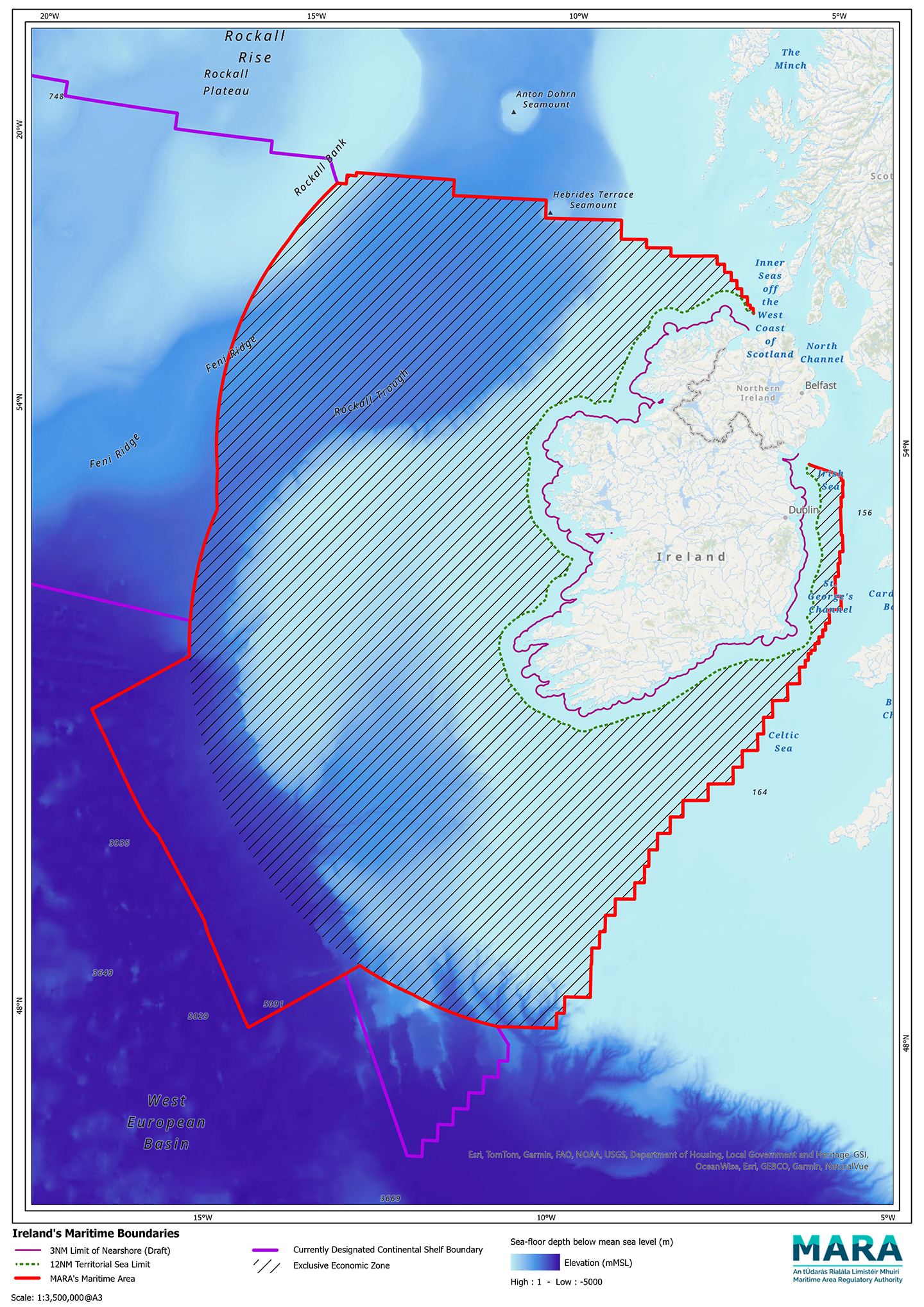
Ireland’s Maritime Area
The Irish EEZ (or Exclusive Economic Zone) extends from the 12 nautical mile (approx. 22.24kms) limit to approximately 200 nautical miles (370kms) off the coast of Ireland in places, as shown in pink in this map of Ireland’s Maritime Area. Ireland has jurisdiction over both living and non-living resources within its EEZ.
Maritime Usage Licence
Schedule 7 of the MAP Act sets out the maritime usages for which a MUL is required.
Maritime usage is defined in section 2 of the MAP Act as:
“maritime usage”, in relation to the maritime area, means any activity, operation, works or development undertaken in that area for any purpose (including conservation), and includes—
(a) the construction or use, or both, of any infrastructure in that area associated with, or otherwise supporting, the activity, operation, works or development, and
(b) the maintenance of such infrastructure,
and references in this Act to “proposed maritime usage” shall be construed accordingly;
It has been clarified in Circular MP01/2025 by the Department of Climate, Energy and the Environment that an activity which is non-commercial and constitutes an individual or group of individuals’ ordinary reasonable enjoyment of the maritime area, or an activity that is of a passive observational nature, is not contemplated to be included in the application of the definition of maritime usage.
Compliance & Enforcement
Yes. First check it is in MARA’s remit to address. Where there is a breach of condition or unauthorised activity, complete the online Complaints Form. Where possible include evidence of the alleged activity. Full details here.
- MARA acknowledges complaints within 5 working days.
- MARA assesses if the complaint falls within its remit and will contact you if more information is required.
- Where the complaint is not within MARA’s remit, it is redirected to the relevant authority and MARA will inform you of the referral.
Seaweed Harvesting and the Maritime Area Planning Act 2021
The Maritime Area Regulatory Authority (MARA) is a relatively new state agency established in July 2023 under the Maritime Area Planning Act 2021 (the MAP Act). As part of its work, MARA is responsible for licensing and subsequent enforcement of a list of activities in the MAP Act which require a Maritime usage Licence (MUL). Activity 10 on this list relates to seaweed harvesting and is worded as follows:
“10. The harvesting, disturbance or removal of seaweed, whether growing or rooted on the seabed, or deposited in or washed up thereon by the action of any one or more than one of the following: (a) tides; (b) winds; (c) waves”. (The activities are set out in Schedule 7 of the MAP Act. The requirement for a licence for a Schedule 7 Activity is set out in section 113 of the MAP Act.)
Therefore, a MUL is required to harvest seaweed, and it is MARA’s responsibility under the MAP Act to ensure that these licences are granted, as appropriate.
No. Under the MAP Act, a Maritime Usage Licence is only required for the harvesting of wild seaweed. Where a person proposes to farm seaweed this is considered aquaculture, and an aquaculture licence is required from the Department of Agriculture, Food and the Marine (See: Aquaculture & Foreshore Management)
This will depend on the purpose for which the seaweed is being gathered. On the basis of a Circular MP01/2025 issued by the Department of Climate, Energy and the Environment in 2025, MARA considers that the harvesting of small volumes of seaweed for personal use and on a non-commercial basis may not require a licence. For example, gathering small amounts of seaweed for use in a domestic garden, or for use in home-cooking would not require a licence. Any other use, particularly for commercial purposes, is likely to require a licence from MARA. Examples include, but are not limited to, gathering seaweed for onward sale to a processor, collecting seaweed to use in products such as candles or cosmetics, or gathering seaweed for sale as a food or ingredient.
Existing Harvesters:
The MAP Act includes provisions, referred to as ‘transitional provisions’, which allow those already engaged in seaweed harvesting, or with existing harvesting rights, to come under the new licensing regime under the MAP Act. (Details of the transitional arrangements are set out in section 129 and section 130 of the MAP Act)
These transitional provisions apply where:
- The relevant person was active in harvesting seaweed prior to August 2021 but does not hold an existing authorisation in which case they may have until 31 July 2028 to apply for a licence from MARA under the MAP Act or,
- The relevant person holds an existing foreshore authorisation, other than a licence from MARA or pre-existing private rights. A licence from MARA may be required and details of the existing authorisation or alleged rights may be requested.
Note that MARA may request evidence of either an existing foreshore authorisation, pre-existing rights, or gathering prior to August 2021 when following up on reported harvesting activity or when an application is made.
People planning to start Harvesting:
If you are not an existing harvester as outlined above then you may require a licence from MARA prior to starting any new seaweed harvesting. You should visit the Applying for a MUL section of the MARA website.
Yes, under the MAP Act the requirement for a Maritime Usage Licence from MARA is separate from any property rights that you may hold.
No. When considering an application for a maritime usage licence, MARA will always seek either evidence of property rights or a declaration from the applicant that no other person or entity holds exclusive rights over the area being sought. If it subsequently emerges that another person or entity holds exclusive rights to an area for which a licence has been granted, that licence may be revoked.
No. A Maritime Usage Licence does not confer an exclusive property right or replace existing rights as it merely grants a right to occupy a particular part of the maritime area for the purposes of undertaking the maritime usage.
In some instances, property rights may be non-exclusive, with several persons or entities holding rights to a portion of the seaweed in an area. In these cases, multiple rights holders may be licensed.
Similarly, some areas of the Irish coastline may have no property or historic rights. In such cases MARA may grant multiple parties a licence to gather seaweed, subject to certain conditions.
MARA does not operate or maintain a register of property rights to the foreshore. Where such rights may exist, MARA encourages rights-holders to ensure that they are registered with Tailte Éireann (formerly the Property Registration Authority of Ireland).
Yes. MARA may impose conditions on a licence, and these can include conditions to protect the environment and ensure the long-term sustainability of the seaweed resource.
No, MARA is only concerned with the activity of seaweed gathering which is the subject of a licence. MARA’s remit does not extend to other regulated areas such as food safety or animal health. However, as part of the licensing process MARA does consult with other public bodies and may consider their submissions in determining whether a licence should be granted.
MARA has a section of its website where a member of the public can raise a concern. Before getting in touch, you should consider the information provided on the website and be aware of the transitional provisions mentioned above at question 16.
If you are considering applying for a licence you can arrange a pre-application meeting with staff from MARA. A pre-application meeting is a non-statutory discussion where staff from MARA can describe the application process and what is required in making an application. Information about the pre-application meeting can be found on the Maritime Usage Licences section of MARA’s website.
MARA has not set defined limits on the length of coastline for which applications will be accepted. However, applicants should consider the fact that any application is subject to environmental and ecological assessment, in compliance with current national and European legislation. Applications for larger areas will inevitably be more complex to assess. On this basis MARA recommends that applications be made for relatively discrete areas of coastline.
Also, as outlined in Question 18, while any person or entity may apply for a licence MARA will seek details of any property rights that may exist in the proposed maritime/licence areas and require guarantees that the permission of property rights holders to engage in seaweed harvesting has been obtained. Should it transpire that these details are not provided, or where it subsequently emerges that any such permission has not been obtained (even in error), a licence may be refused or subsequently be revoked in its entirety.
MARA cannot provide indicative timeframes for determination of licence applications. The process is subject to statutory assessment in accordance with the requirements set out in the MAP Act and other legislation. Applications are subject to consultation with public bodies and may also require public participation and consultation. The quality and completeness of the information provided can also influence determination times, as can the complexity of the maritime area in which the application is made.
MARA may also prioritise certain licence applications in line with national sectoral, policy or project priorities.
No. MARA must record the precise location of all licences it grants, so a precise mapping is required. You may be able to engage an engineering or environmental consultant who can help you prepare maps in accordance with MARA’s Technical Mapping Guidance. For small application areas, MARA has prepared guidelines to help you prepare maps using publicly available resources and you should discuss this at a pre-application meeting.
Not at present. MARA has recently commenced the assessment of several applications related to seaweed harvesting, and when these are determined, the licence, if granted, will be published on the MARA website, see Applications and Determinations.
No. All applications received by MARA are published on its website (see Applications and Determinations). If you believe that parts of your application are commercially sensitive, you should include this information on a separate document with numbered details and then refer to the detail number in your application. Please be aware however that even where you indicate that certain information is commercially sensitive, MARA may be obliged to release this information in compliance with the Freedom of Information Act 2014 (as amended) and the Access to Information on the Environment Regulations.
No.
Applications for all types of Maritime Usages, as set out in Schedule 7 of the MAP Act, are currently submitted using the same form, which is provided on the Applying for a MUL section of the MARA website. As mentioned above, MARA is currently assessing several applications relating to seaweed harvesting and may in the future introduce a seaweed specific application form based on the experience of these assessments.