
ORESS 2.1 – Tonn Nua / MAC FAQ
ORESS 2.1 – Tonn Nua
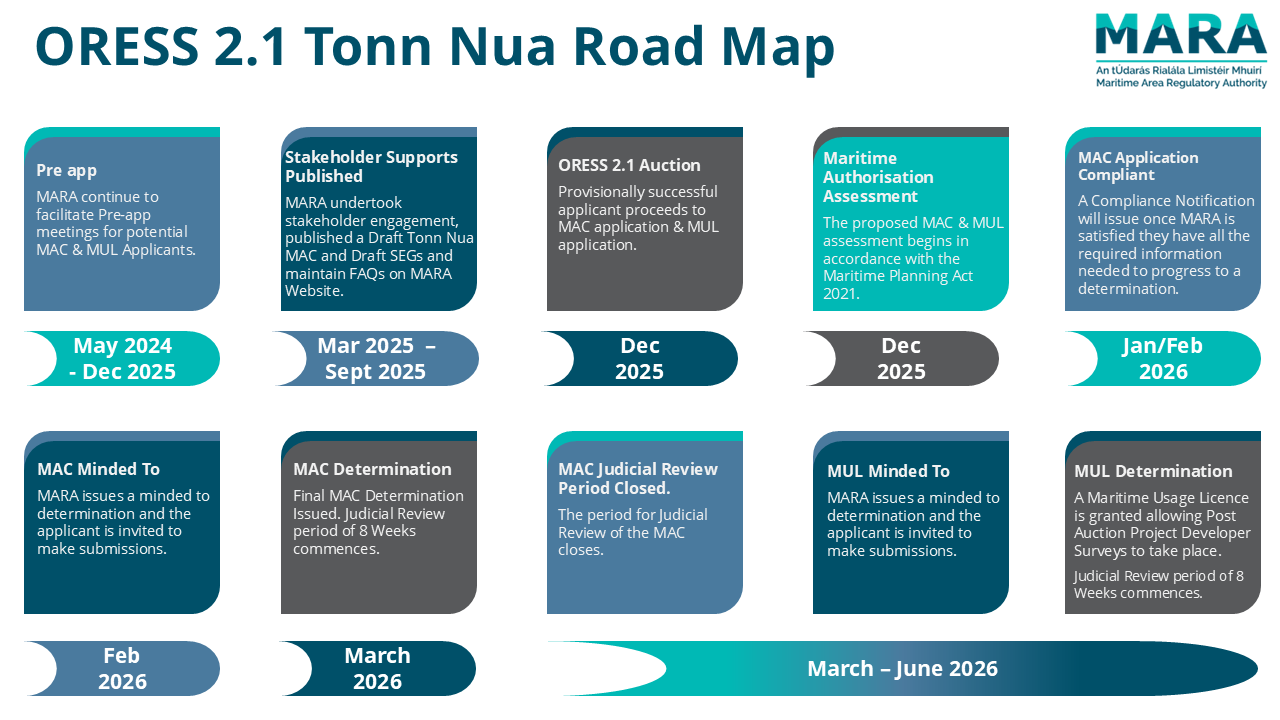
MARA has prepared the below Roadmap in support of Tonn Nua
ORESS 2.1 – Tonn Nua FAQ
Listed below are some of the most frequently asked questions in relation to Maritime Authorisations for Tonn Nua. These have been split over three headings, MAC General Questions, MAC Financial Questions, MAC Technical Questions and MUL General Questions. Click on the arrow beside the questions to expand and view additional details. MARA will continue to update this FAQ as queries arise, any further queries may be directed to mac@mara.gov.ie
MAC General Questions
MARA recommends that all ORESS bidders engage MARA for a MAC pre-application meeting. This meeting serves to provide clarifications on the MAC application process and requirements. Please note pre-assessment of application details will not be given within these meetings. Pre-application meetings are held on a non-statutory basis and without prejudice to any future MAC applications.
ORE pre-applications are prioritised by MARA Please complete Pre-Application Consultation Request Form and submit to mac@mara.gov.ie
No, MARA do not publish details of pre-applications held. Pre-application meetings are held on a non-mandatory basis and without prejudice. Brief notes of the meeting are recorded.
Yes. All transmission and supporting infrastructure, including the cable route, substations and nearshore infrastructure which falls within the maritime area will require a MAC(s). The winner or ORESS 2.1 for Tonn Nua shall apply for the full Area A which is designated for the windfarm array.
MACs are typically granted on a non-exclusive basis. It is envisaged that the Eirgrid and Developer MAC (Tonn Nua Area A) will overlap. This is subject to Terms and Conditions of ORESS 2.1 and connection agreements between Eirgrid and the Developer. Following the grant of these MACs, the holder may apply to MARA to amend the MAC or assign a part of the MAC.
No. Requirements in relation to the Community Benefit Fund are included under the Terms and Conditions of the ORESS 2.1 Auction.
The applicant may cross reference any preparatory work undertaken by DCEE to establish the SC-DMAP. The applicant should also detail any preparatory work they plan to undertake pre-planning.
Yes. Applications for MACs and MULs are prioritised in accordance with MARA’s prioritisation system. Application for the ORE within a DMAP and related activity are highly prioritised by MARA.
MARA has developed a dynamic and structured system for the prioritisation of all MAC and MUL applications to provide for effective decision making and to ensure that applications of national strategic importance are prioritised and delivered in a timely manner. When a complete application is received, and the fee has been paid, the application is ranked according to four specific prioritisation criteria; namely National and European priorities, Policy and Regulatory, Assessment Status and Application Age.
Applications for MACs and MULs are prioritised in accordance with MARA’s prioritisation system. Application for the ORE within a DMAP and related activity are highly prioritised by MARA.
Further details in relation to MARA’s application prioritisation system available here.
The Supporting Entity Guarantee is to ensure payment of levy up to commercial operation / build completion. “Commercial Operation Date” means the date that the Project achieves commercial operation as defined in the MAC.
The MAC levy shall be in accordance with Levy Framework as published on the MARA website: here. This levy framework is developed in accordance with Section 92 of the MAP act and requires the consent of the Minister for Public Expenditure, Infrastructure, Public Service Reform and Digitalisation. MARA is obliged under the MAP act to keep this framework under review.
MARA considers grid cost adjustments to be excluded from the calculation of the annual 2% gross revenue levy at operation stage of Tonn Nua projects.
The MAC levy shall be in accordance with Levy Framework as published on the MARA website: Here
Applications for MACs and MULs are prioritised in accordance with MARA’s prioritisation system. Application for the ORE within a DMAP and related activity are highly prioritised by MARA.
Timeframes for determination will be dependent of the quality of applications, and response by applicants to any notices issued.
According to Section 7.3.9 of the Terms and Conditions for the ORESS 2.1 Auction, the provisional winner of the ORESS Tonn Nua Auction must make a MAC application in respect only of the Project Development Area specified in the Designated Maritime Area Plan (and not a greater or lesser area).
Upon request, MARA will set up a file-sharing cloud platform to enable the submission of MAC applications. MARA can also accept submissions via email up to 20MB.
Note in order for an application to be considered complete, the application fee must be paid in full. Details of how to pay the application fee are available at Section 2.6 of Guidance Note for Applicants applying for a Maritime Area Consent (MAC)
No. Please refer to 7.3.9 and Section 10 of the Terms and Conditions for ORESS 2.1 Auction. Once a preliminary auction winner is announced, they shall apply to MARA for a MAC. MARA will independently assess and determine the MAC application.
No. The applicant is not required to prepare a MAC map or GIS files for the Tonn Nua Area A. MARA shall prepare the MAC map based on the SC-DMAP area published by DCEE. The application is expected to cover the entire area of the Area A.
The Scope and Nature of the Maritime Usage to be undertaken must be fully described and should detail any works or activities in the Maritime Area required or necessary, as relevant, to undertake, construct, complete, commission, operate, maintain, decommission and rehabilitate the proposed usage.
As set out in the Guidance Note for Applicants applying for a Maritime Area Consent (MAC, Part 5 “Tax Compliance – The applicant must be tax compliant, both at the time the application is made and at the time that the MAC application concerned is determined by MARA.” Tax Registration Number and Tax Clearance Access Number are required to be submitted for the applicant.
The applicant may cross reference any preparatory work undertaken by DCEE to establish the SC-DMAP. The applicant should also detail any preparatory work they plan to undertake pre-planning.
The applicant may cross reference any stakeholder engagement undertaken by DCEE to establish the SC-DMAP. The applicant should also detail any stakeholder engagement they plan to undertake pre-planning.
The revised General Guidance notes for Applicants, which includes Technical and Financial Guidance along with Application forms were published on 20 August 2025. Please see Applying for a Maritime Area Consent – MARA – The Maritime Regulator.
The revisions provide additional clarity and transparency in relation the MAC process and application requirements. There was no material change to the benchmark requirements for MAC application assessment.
Please use the current guidance an application forms on our website.
If an applicant wishes to submit additional supporting information along with their application form, they may do so by clearly appending the additional document and cross referencing these within the general application form. All supporting information submitted should be relevant to the MAC application and the criteria to which MARA may have regard to, as set out within Schedule 5 of the Maritime Area Planning Act 2021, as amended.
Letters of reference may be included within the application, where deemed appropriate, to evidence that the applicant is fit and proper.
EirGrid have made a Maritime Usage Licence application for marine survey works proposed to commence in 2025 to enable site and cable route selection. EirGrid have indicated that they intend to make a MAC application to MARA following site and cable route selection. EirGrid currently project that they shall make a MAC application to MARA in early 2027 following pre-application engagement over 2025 and 2026 in line with project evolution. Please refer to Offshore Energy Future Projects – EirGrid in relation to EirGrid’s plans for Government’s South Coast DMAP. Application for the ORE within a DMAP and related activity are highly prioritised by MARA.
MARA will follow the formal legal process. MARA will inform DCEE and the applicant of any judicial review taken and provide updates with regard to timeframes. Once any Judicial Review is concluded, MARA will engage with DCEE and the applicant on the outcome.
A rehabilitation bond may include an irrevocable draw down letters of credit / bank guarantees / performance bonds, and subject to Ministerial approval an upfront cash deposit account or a cash accrual account. Parent Company Guarantees are typically not acceptable as a primary source of security but may be used by agreement with MARA in exceptional circumstances as a short-term form of security
All works, including temporary works, activities and structures must be located within the boundary of the MAC area. This includes the full span of turbine blades (i.e. overhang) and all temporary works, including anchors, buoys etc.
According to Section 7.3.9 of the Terms and Conditions for the ORESS 2.1 Auction, the provisional winner of the ORESS Tonn Nua Auction must make a MAC application in respect only of the Project Development Area specified in the Designated Maritime Area Plan (and not a greater or lesser area)
There is legislative provision under Section 88 and Section 89 of the MAP Act where the holder of a MAC may make an application in the specified form, accompanied by the specified fee, to the MARA for the surrender of a MAC.
MAC Financial Questions
Please note MARA adopts a comply or explain approach under the Financial Capability Assessment. Further details are provided under Section 6 – Comply or Explain in Appendix C of Guidance Note for Applicants applying for a Maritime Area Consent MAC.
Refer to Section 9 – Ongoing Compliance in Appendix C of Guidance Note for Applicants applying for a Maritime Area Consent MAC.
In order to prove financial capability, a Relevant Person may rely on the resources of another entity(s) or undertaking(s), which may be a parent or a non-parent company (“Supporting Entity”). Where this is the case, the financial capability assessment will be carried out on the Supporting Entity(s) and not the Relevant Person.
Where a Supporting Entity(s) is relied on to meet financial test thresholds, a Supporting Entity Guarantee (“SEG”) must be signed. The SEG does not form part of the financial capability assessment and the purpose of SEG is to ensure payment of levy up to commercial operation / build completion.
MARA considers all types of credible funding arrangements. Please refer to Section 7 – Funding Arrangements in Appendix C of Guidance Note for Applicants applying for a Maritime Area Consent MAC. A Relevant Person may obtain or provide a letter of credit from a financial institution (e.g., a bank) guaranteeing the payment of costs on time where the Relevant Person is unable to cover its Project Costs.
All related letter of credit documentation should be submitted with the MAC application. In cases where a MAC is granted in advance of funding arrangements being finalised, documented evidence of secured funding must be furnished to MARA.
The definition of Project Costs is any cost/financial commitment including capital, financing and other but excluding contingent liabilities in respect of a MAC project. Project costs includes all costs up to and post Build Completion or COD, including but not limited to design, planning and construction. Refer to the Financial Capability Assessment Guidance for further details.
The definition of Outstanding Projects is depending on the stage of the project, Outstanding Project Cost is calculated as follows: – Up to FC: Any cost/financial commitment including capital, financing and other but excluding contingent liabilities, associated with a proposed project or a granted MAC, which has not yet been incurred/expensed up to the estimated date of FC. – Post FC: Any cost/financial commitment including capital, financing and other but excluding contingent liabilities, associated with a proposed project or a granted MAC, which has not yet been incurred/expensed up to the estimated date of COD. Refer to the Financial Capability Assessment Guidance for further details.
Please refer to Terms and Conditions for ORESS 2.1 Auction
No, the Tonn Nua MAC Holder will not be required to reserve cash on an annual basis. However, the Holder will be required to post a Rehabilitation Bond not later than 60 days prior to the commencement of any works on foot of Development Permission, as set out in Condition 16 of the Draft Tonn Nua MAC.
Responsibility for agreeing a rehabilitation plan in relation to MACs (Section 75(1)) rest with the planning authority. However, project costs should include estimated project costs for rehabilitation in order to ensure the applicant is financially capable of delivering and rehabilitating the project.
The applicant for the windfarm should include rehabilitation cost for their infrastructure and Eirgrid should provide rehabilitation costs for transmission infrastructure
No, there is no such process in place at present.
It is preferable that changes to applicant entities are not made during the application process, particularly with regard to the relevant person(s) for the purpose of financial or technical capability assessment. Such changes will/may require full financial and/or technical capability reassessment and result in delayed timeframes for the MAC determination.
Yes. Section 85 of the MAP Act specifies an assignment process
A sample is provided here. Based on information submitted in the relevant application form, MARA will draft a SEG, which must be signed by the Supporting Entity. Upon receipt of the original signed SEG, it will be reviewed and verified by MARA and an executed copy of the SEG will be sent to the Relevant Person. The original executed document will be retained by MARA. Note: the above template is subject to change
The Supporting Entity Guarantee is to ensure payment of levy up to commercial operation / build completion i.e. the Development Stage Levy. “Commercial Operation Date” means the date that the Project achieves commercial operation as defined in the MAC.
The Holder shall pay to the Grantor the specified levy within one month from the commencement date of the Maritime Area Consent (MAC) and on every succeeding anniversary for the term of the consent. The Levy is calculated according to The Levy Framework as published on MARA’s website. All levies are indexed to the Harmonised Index of Consumer Prices (HICP), applied on an annual basis.
Supporting Entity is to cover the full levy (i.e. 100%).
The Relevant Person’s share of all Outstanding Project Costs in each MAC project or application, will be factored into the financial resources test of the Relevant Person.
Total Outstanding Project Costs Up to Financial Close is defined as: Any cost/financial commitment including capital, financing and other but excluding contingent liabilities, associated with a proposed project or a granted MAC, which has not yet been incurred/expensed up to the estimated date of Financial Close.
The supporting entity relied upon for the purpose of the financial capability assessment is required to provide the supporting entity guarantee.
A supporting entity guarantee is required.
Applicants are not required to submitted the SEG template as part of their MAC application.
Based on information submitted in Form B of the Financial Capability Assessment Application Forms, MARA will draft a Supporting Entity Guarantee (SEG). Further information in relation to the SEG process is provided within Appendix C of MARA’s Guidance Note for Applicants applying for a Maritime Area Consent (MAC)
Any supporting entity guarantee for multiple guarantors will follow a similar format to the Supporting Entity Guarantee published on 5th September save for adjustments necessary to reflect multiple guarantors.
As per the draft opinion published on MARA’s website, it “is a draft opinion only and it may be subject to change depending on the circumstances of the Project” and that applicants “may liaise with the MARA in relation to the specific details of any proposed guarantee”.
MARA are not in a position to agree any changes to the opinion outside of the MAC application process. Once a MAC application is received and MARA has circulated a Supporting Entity Guarantee for execution, where applicable, MARA are open to engaging on any issues surrounding the opinion.
MAC Technical Questions
Yes. Where a Relevant Person is unable to meet any of the technical capability requirements, this will not automatically result in the Relevant Person failing the technical capability assessment. However, the onus is on the Relevant Person to provide a sufficient explanation for each requirement not met, along with supporting evidence of extenuating circumstances or mitigating actions.
The Comply or Explain policy relates to all MAC applications including ORE applicants for the technical capability assessment and MARA reserves the right to deem applicants fit and proper based on the information submitted. The “Comply or explain” approach gives MARA the flexibility to make realistic decisions about applicants current and committed resources which in turn is likely to lead to better outcomes in relation to regulation of the maritime area while also encouraging openness in the application process.
Yes, delivery timelines must demonstrate how first generation will be achieved in advance of the 2034 long stop.
Maritime Area Consent MAC Technical Capability Assessment for Schedule 10 Projects Form TCA1
Yes, provided the elements of the project used to demonstrate the criteria were undertaken by the relevant person.
It is not expected that applicants would use 6 projects to demonstrate 12 months continuous experience for any given stage. The maximum expected input for the final cell in the table in Section 4.3 should be 3 pages for each stage. i.e. 9 pages in total.
Maritime Area Consent MAC Technical Capability Assessment for Schedule 10 Projects Form TCA1
The rehabilitation schedule should be that as approved by the planning authority as part of development permission.
Maritime Area Consent MAC Technical Capability Assessment for Schedule 10 Projects Form TCA1
The guidance note does not stipulate what percentage of each senior team member’s availability must be dedicated to the project overall. However, if an applicant is depending upon a single senior team member to demonstrate the 10 years’ experience required for a particular criteria, it is expected that the relevant team member would be available to the project on a full-time basis for the stage to which their experience relates. For example, a project team member who has been put forward to demonstrate 10 years prior offshore wind development and construction experience should be 100% available to the project during the development and construction stages. It is acknowledged that experienced team members will work on other projects/roles within an organisation from time to time. Please note that being 100% available to work on the project does not mean that the senior team member only works 100% of their time on that project.
Maritime Area Consent MAC Technical Capability Assessment for Schedule 10 Projects Form TCA1
Yes, demonstration of satisfactory operation and maintenance experience may be met by ownership of an offshore wind project greater than the defined capacity that has passed the milestone of first generation in excess of 12 months.
A Senior Member of the Team shall be able to demonstrate at least 10 years of experience of the Planning system delivering projects of a similar scale and nature (including terrestrial projects).
As per Appendix B Technical Capability Assessment Guidance, Guidance note for Applicants applying for a Maritime Area Consent (MAC) (applying to Schedule 10 Projects), the Project Delivery Team Experience of senior members of the team for Offshore Renewable Energy Projects shall be able to demonstrate at least 10 years of experience, for each of the following:-
(a) at the development and construction stages of an offshore wind farm up to the point at which first generation of all or part of the offshore wind farm is achieved;
(b) of renewable energy development experience where development experience means the development and construction stages of a renewable energy development up to the point at which first generation of all or part of the renewable energy project is achieved; and
(c) of the Irish Planning system delivering projects of a similar scale and nature (including terrestrial projects).
Overall, this approach aims to foster a wider range of participation and expertise in the emerging local offshore wind sector.
The guidance note covers all types of MAC applications, and the list of preparatory works which the applicant may have undertaken is not prescriptive. Applicants are only required to list preparatory works which are relevant to their application. MARA do not expect applicants to have completed a Navigational Risk Assessment at Tonn Nua MAC application stage. Navigational issues will be considered by An Coimisiún Pleanála as part of the Tonn Nua development consent process.
Derived data is any data that is directly calculated or processed from the data types enumerated under the definition for Data at 1.1(g)(i) to (iii) in the Draft Tonn Nua MAC. It does not include design or process information.
Data will be treated as confidential by MARA and any entity holding data on its behalf up until the point a planning application is submitted to An Coimisiún Pleanála, as set out in condition 10.8 of the Draft Tonn Nua MAC. However, it should be noted that this confidentiality is subject to MARAs obligations under law as set out at section 10.10 of the Draft Tonn Nua MAC.
The MAC holder should engage with MARA at the earliest opportunity if it is anticipated that the timeframe cannot be met. MARA acknowledge that specific circumstances may arise where it is not beneficial to transfer data to MARA or an entity holding data on MARA’s behalf and this may be agreed by MARA at its discretion.
MUL General Questions
Yes, a MUL application can be submitted at any time. However, no assessment of MUL applications for the Tonn Nua area will begin until a MAC application from the provisional winner of ORESS 2.1 has been received by MARA.
The MUL application will be assessed in accordance with MARA’s processes and procedures.
Only the MUL application from the preferred bidder of the ORESS 2.1 process will be prioritised and assessed in parallel with the Tonn Nua MAC application.
A determination in relation to the Tonn Nua MUL will only be made following determination of the Tonn Nua MAC application.
Only one MUL will be awarded to the ORESS 2.1 provisional winner subject to the applicant satisfying legislative requirements in relation to the MUL application and having been granted the Tonn Nua MAC.
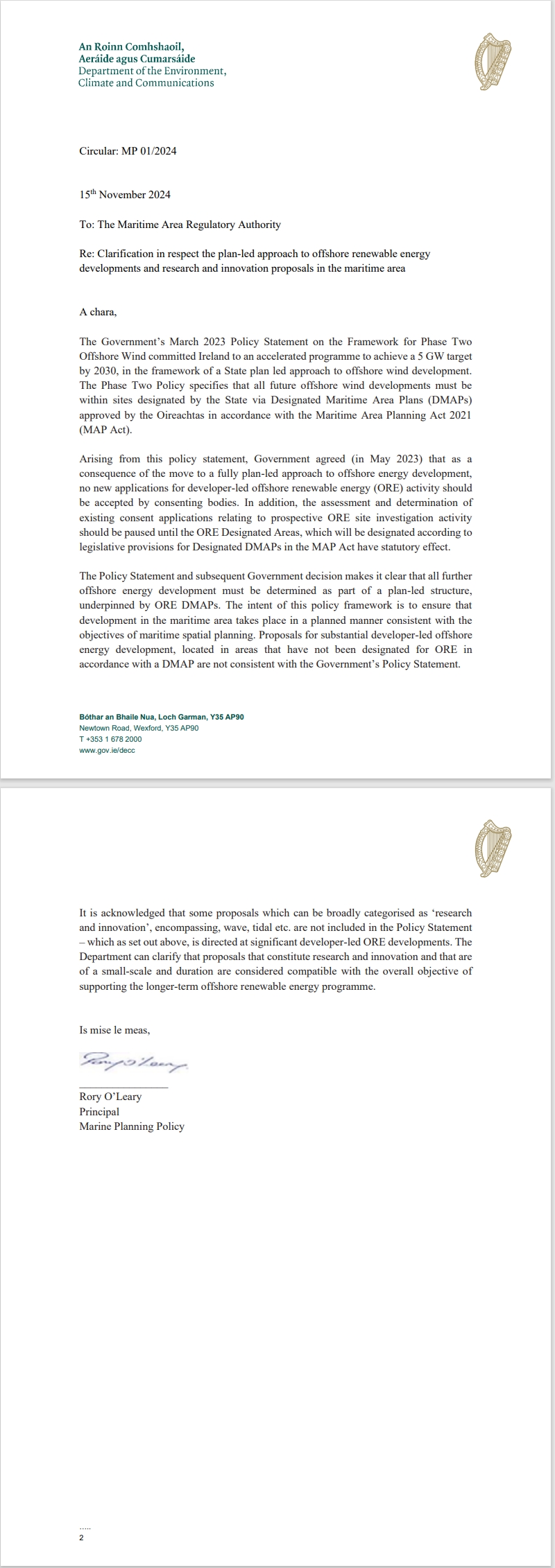
MARA will have regard to government policy when considering any other MUL applications for Tonn Nua (Refer to Circular MP01/2024).
Yes. Pre-application meetings can be arranged by completing Pre- Application Request Form and submit to licence@mara.gov.ie.
ORE pre-applications are prioritised by MARA.
Applications for MACs and MULs are prioritised in accordance with MARA’s prioritisation system. Application for the ORE within a DMAP and related activity are highly prioritised by MARA.
Timeframes for MUL determination will be dependent on the quality of applications, response by applicants to any notices issued and any the nature and number of submissions received in response to public consultation.